Welcome, aspiring digital marketer! Are you ready to unlock the power of the internet to supercharge your business? Whether you're a small business owner, an entrepreneur, or just curious about how online strategies work, you've landed in the right place. Digital marketing might seem like a complex world, but at its heart, it's about connecting with your customers where they spend most of their time: online!
In this friendly and knowledgeable guide, we'll break down the essentials, making it easy for you to understand and implement effective digital marketing solutions. We're here to help you grow your business, build stronger relationships with your audience, and significantly boost your online presence, fast. So, let's dive in and explore the exciting possibilities together!
Table of Contents
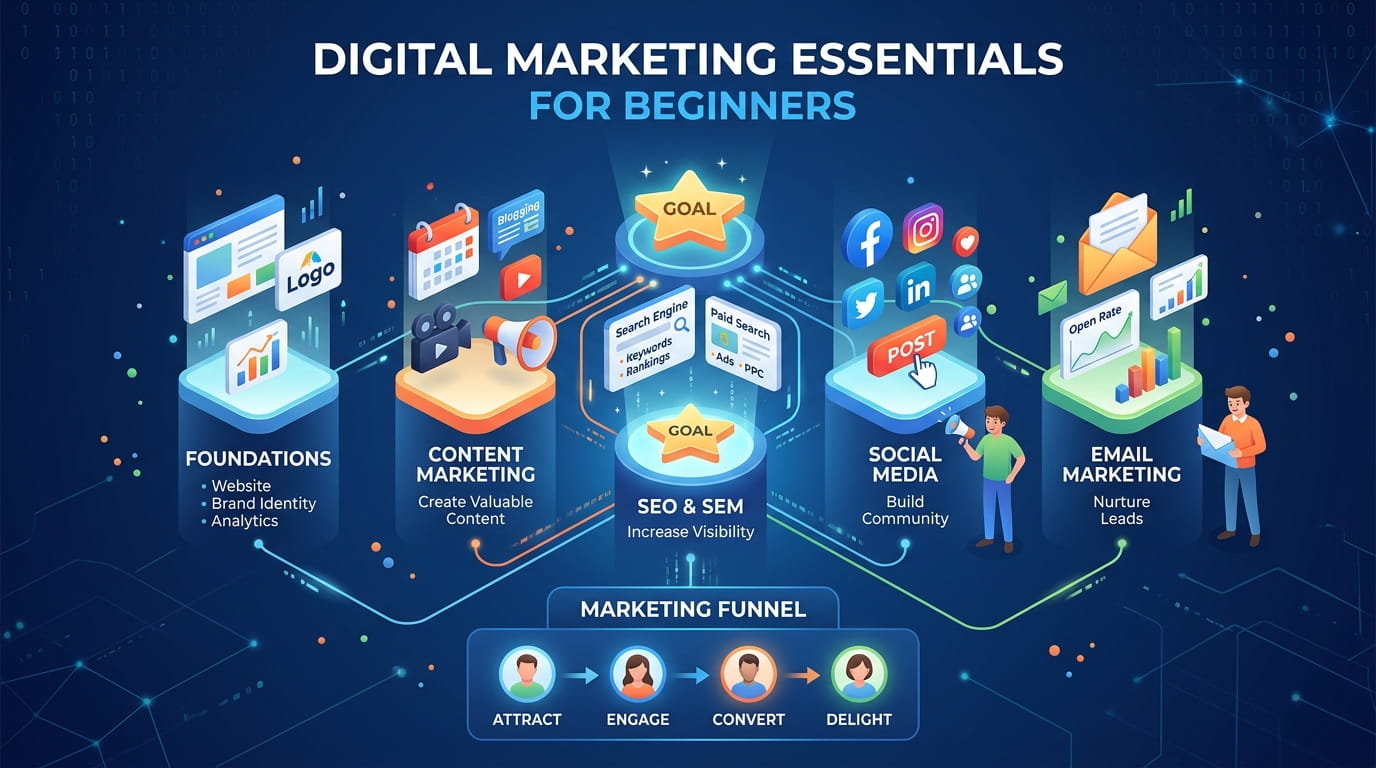
What is Digital Marketing and Why Does It Matter?
Building Your Online Foundation: Website and SEO Basics
Content is King: Engaging Your Audience with Valuable Information
Mastering Social Media: Connecting and Building Community
The Power of the Inbox: Essential Email Marketing
Instant Visibility: Getting Started with Paid Advertising (PPC)
Showing Up Locally: Local SEO for Brick-and-Mortar Businesses
Captivating Audiences: Introduction to Video Marketing
Reaching Customers on the Go: Mobile Marketing Strategies
Making Sense of the Data: Digital Marketing Analytics
Crafting Your Digital Marketing Strategy
Key Takeaways
1. What is Digital Marketing and Why Does It Matter?
Digital marketing, in simple terms, is any marketing activity that uses an electronic device or the internet. It's a broad umbrella that covers everything from your website to social media posts, email campaigns, and online ads. Unlike traditional marketing, which often relies on one-way communication through print or TV, digital marketing is highly interactive. It allows for real-time conversations with customers, helping you build trust and foster relationships that are crucial for growth.
For small businesses especially, digital marketing is a game-changer. It puts your business in front of more potential customers than traditional methods, often at a lower cost. Imagine running a targeted social media ad campaign for as little as $25 and reaching thousands of potential customers in your local area! This ability to reach a wider audience and track your return on investment (ROI) makes it an incredibly powerful tool.
One of the greatest benefits of digital marketing is its scalability and measurability. You can start small, test different approaches to find what works, and then scale your marketing spend as your business grows. Plus, nearly every action can be tracked and analyzed, giving you valuable insights into what's working and what's not. This data allows you to make informed decisions and refine your strategies for even better results.
Digital marketing truly levels the playing field, allowing even the smallest enterprises to compete with larger brands by connecting directly with their target market. It's not just about selling; it's about building brand awareness, attracting new customers, and fostering loyalty through diverse online opportunities.
2. Building Your Online Foundation: Website and SEO Basics
Your website is often the cornerstone of your digital presence. It's your online storefront, your information hub, and a key tool for connecting with customers. But simply having a website isn't enough; people need to be able to find it! That's where Search Engine Optimization, or SEO, comes into play. SEO is the process of improving your website to help it appear more prominently in relevant search results on platforms like Google.
Think of it this way: when someone needs a product, service, or information, they often head straight to a search engine. If your website shows up among the top results, you can attract visitors who are actively looking for what you offer. This "organic" traffic is incredibly valuable because it's free, targeted, and generally trusted more than paid ads.
So, how do you make your website more visible? It starts with making sure search engines can "crawl" (find) and "index" (store your pages in their database) your site. Beyond that, optimizing your individual pages is crucial. This includes using relevant keywords in your content, creating compelling title tags (the clickable headline in search results), and writing engaging meta descriptions (the short summary under the title). Structuring your content with header tags (like H1, H2, H3) also makes it easier for both search engines and users to understand.
Don't forget about mobile optimization! Google prioritizes the mobile version of your site's content, so a mobile-friendly website that loads quickly and is easy to navigate on smaller screens is absolutely essential for good SEO. By focusing on these SEO basics, you'll be well on your way to earning consistent organic traffic without constantly paying for visitors.
3. Content is King: Engaging Your Audience with Valuable Information
Content marketing is the strategic creation and distribution of valuable, relevant, and consistent content designed to attract and engage your target audience. Unlike traditional advertising, which often pushes a message, content marketing pulls people in by offering something they genuinely find useful, like blog posts, videos, or infographics. The goal is to build trust, educate your audience, and ultimately drive profitable customer actions.
This form of marketing helps your audience become aware of your brand, earns their trust in your products or services, generates leads, and ultimately drives conversions and sales. It's about establishing expertise and thought leadership in your field by consistently sharing high-quality information. When done right, content marketing can generate more leads at a lower cost than traditional methods, and once created, the content continues to deliver value over time.
Developing a successful content marketing strategy involves several key steps. First, define your objectives. What do you want your content to achieve – brand awareness, lead generation, or sales? Then, deeply understand your audience. Create detailed buyer personas to grasp their needs, pain points, and preferences, allowing you to tailor content that truly resonates with them.
Finally, plan and create your content, focusing on quality, relevance, and value. Use a content calendar to ensure consistent publishing across various channels like your website, email newsletters, and social media platforms. Remember, you can't just create content and expect people to find it; you need to promote it effectively through different channels, and ensure you offer clear calls to action for further engagement.
Social media marketing involves using platforms like Instagram, Facebook, TikTok, LinkedIn, and others to promote your business, engage with your audience, and build meaningful relationships. It's a powerful way to connect with customers, increase brand awareness, and drive traffic to your website.
To succeed on social media, you first need to understand your audience. Who are you trying to reach? What are their demographics, interests, and preferences? Analyze your existing social media audience and customer base to gain these insights. This understanding will help you choose the right platforms where your target buyer spends the most time and tailor your content to them.
Next, set clear, measurable goals. Instead of a vague goal like "get more followers," aim for something specific like "increase Instagram followers by 20% in three months" or "generate 100 new leads from Facebook in 60 days". Your goals will help you define your success metrics and calculate your return on investment. Common goals include increasing brand awareness, generating leads, boosting engagement, or driving website traffic.
When it comes to content, variety is key. Don't just promote your products; entertain, educate, and inspire your followers. Share behind-the-scenes glimpses, customer stories, testimonials, or simply ask questions to start conversations. Consistency in posting and maintaining a consistent brand voice across platforms will help build rapport with your audience. Tools like Buffer and Hootsuite can help you schedule posts and manage multiple platforms efficiently.
Engagement is paramount on social media. It's not just about likes; it's about meaningful interactions. Respond to comments and messages, run polls, and create content that encourages two-way communication. Regularly evaluate your performance by tracking metrics like engagement rate, reach, and link clicks to see what's working and what needs adjustment.
5. The Power of the Inbox: Essential Email Marketing
Email marketing is the practice of sending commercial messages to a group of subscribers who have willingly opted in to hear from you, using email as the delivery method. These messages can range from promotional announcements about new products or offers to valuable newsletters providing tips and guides, or even exclusive discounts that incentivize customer loyalty. Email marketing remains one of the most cost-effective forms of digital marketing, offering an impressive return on investment, sometimes as high as $42 for every $1 spent!
One of the biggest advantages of email marketing is direct communication. It allows you to engage with your customers personally through their inboxes, fostering stronger relationships and building greater brand awareness over time. Since subscribers have opted in, they are typically more receptive to your messages, making it an excellent channel for nurturing relationships with existing customers and attracting new ones.
Getting started with email marketing involves a few key steps. First, choose an email marketing platform that fits your needs and budget. Many platforms offer easy-to-use drag-and-drop builders, basic automation, and list management features. Next, focus on building your email list organically. Embed simple opt-in forms on your website, offer irresistible incentives like discounts or freebies, and collect emails during in-person interactions.
Once you have your list, craft compelling email campaigns. Personalization is key; even simple touches like using a subscriber's first name can significantly increase open and click-through rates. Segmenting your audience based on their interests or behavior allows you to send more relevant messages, which further boosts engagement. Consistency in your sending frequency also builds familiarity and trust with your audience.
Remember to track your performance by monitoring key metrics like open rate, click-through rate, conversion rate, and unsubscribe rate. These insights will help you understand what's working and allow you to continuously optimize your campaigns for better results. Email marketing, when integrated effectively into your overall strategy, can be a powerful driver of engagement and sales for your small business.
6. Instant Visibility: Getting Started with Paid Advertising (PPC)
Paid advertising, often referred to as Pay-Per-Click (PPC), is a digital marketing model where advertisers pay a fee each time one of their ads is clicked. Essentially, it's a way of buying visits to your site rather than trying to earn them organically through SEO. PPC ads can take many forms – text, images, videos – and can be displayed on search engines, websites, social media platforms, and more.
The primary purpose of PPC advertising is to drive targeted traffic to your website or landing page quickly. One of the main benefits is its specific targeting capabilities. PPC allows you to reach highly specific audiences based on demographics, keywords, and behavior, and you can even retarget users who previously visited your site. This means you can get your message in front of people who are already demonstrating high intent to purchase or engage.
Starting a PPC campaign generally involves a straightforward process. First, you'll select your campaign type and ad format based on your objective, then choose your settings and targeting criteria (audience, devices, locations, schedule). Next, set your budget and bidding strategy, determining how much you're willing to spend on the entire campaign and per click.
Crucially, keyword research is fundamental to effective PPC campaigns. You need to identify the relevant search terms your potential customers are likely to use, and then craft compelling ad text and creatives that resonate with them, including clear calls to action (CTAs). Finally, it's essential to monitor and optimize your ads regularly. This means tracking performance metrics like click-through rates (CTR), cost-per-acquisition (CPA), and conversion rates, and adjusting your bids and ad copy based on the data to continuously improve.
If your business serves customers in a specific geographic area, local SEO is an absolute must. Local SEO is the process of optimizing your online presence to attract customers from local searches, such as "coffee shop near me" or "plumber in Austin". It's a powerful tool that helps your ideal audience find you faster and easier by bringing you to the top of their local search results, like Google's local map pack.
Think about how often you search for businesses or services "near me." The results you get are typically optimized for local SEO, ready to grab your attention and your business. For local businesses, optimizing for local SEO can provide a tremendous boost in visibility to your target market, driving more foot traffic and nearby customers directly to your door.
The backbone of local SEO is your Google Business Profile (formerly Google My Business). It's crucial to claim and optimize this listing with accurate business name, address, and phone number (NAP) information, high-quality photos, and updated details. Inconsistencies in your NAP across different online platforms can hurt your local rankings, so consistency is key.
Beyond your Google Business Profile, local SEO involves a few other important steps. Conduct keyword research to identify local search terms your audience uses, adding geo-modifiers like your city or neighborhood to general search terms. Create localized content on your website that's relevant to your community, discussing local events or answering common questions specific to your area. Encourage customer reviews on your Google Business Profile and other local directories, as these play a significant role in local search rankings and building trust. Additionally, engaging with your community through offsite SEO activities like link-building with other local businesses can further boost your visibility.
8. Captivating Audiences: Introduction to Video Marketing
Video marketing involves using video content to promote your brand, product, or service. It's about creating engaging videos that share messages, tell stories, or explain ideas in a way that’s far more captivating than just text or static images. Whether it's a short 15-second Instagram reel, a longer tutorial, customer testimonials, or behind-the-scenes glimpses, video marketing aims to grab attention quickly and communicate effectively.
The power of video is undeniable. It doesn't just engage; it motivates action. Videos can significantly improve conversion rates; for example, landing pages with videos often convert better, and explainer videos can clarify complex ideas, reducing doubts and building trust, which ultimately leads to more purchases. Furthermore, video content can boost your SEO efforts, keeping visitors on your site longer and signaling to search engines that your content is valuable.
To get started with video marketing, begin by defining your objectives and understanding your audience. What are you trying to accomplish – more website traffic, increased sales, or improved brand awareness? Who are you trying to reach, and what kind of content appeals to them? This understanding will guide your content decisions and help you choose the best platforms for distribution.
Next, develop a video marketing strategy. Plan the type of content you'll create (product demos, tutorials, interviews), how frequently you'll post, and which video platforms (YouTube, Instagram, TikTok, Facebook) your audience is most active on. Outline your script, keeping it conversational and incorporating a compelling hook within the first few seconds to retain viewer interest. Always include a clear call to action. Finally, focus on quality: clear visuals, good audio (viewers forgive grainy video but not poor sound), and engaging storytelling are paramount to making your brand seem professional.
9. Reaching Customers on the Go: Mobile Marketing Strategies
In today's fast-paced world, mobile devices are constantly in our hands, making mobile marketing an indispensable part of any digital strategy. Mobile marketing encompasses tactics designed to reach and engage customers through their smartphones and tablets. This includes mobile-optimized websites, SMS campaigns, mobile apps, push notifications, QR codes, and location-based marketing.
The importance of mobile marketing cannot be overstated. Mobile e-commerce now accounts for a significant portion of all online sales, and consumers increasingly expect to engage with brands on their mobile devices. Shoppers not only buy via mobile browsers and apps but also complete entire customer journeys on their smartphones. Brands that don't prioritize a mobile marketing strategy risk missing out on prime opportunities to connect with their audience.
A foundational element of mobile marketing is ensuring your website is optimized for mobile visitors. This means having a responsive web design that automatically adapts to different screen sizes, fast load times, and easy-to-read content without intrusive pop-ups. Your website, ads, and marketing content should be not just mobile-friendly, but truly mobile-optimized.
Other effective mobile marketing strategies include:
SMS marketing campaigns: With high open and engagement rates, SMS is excellent for sharing exclusive offers, interactive content, or order updates with loyal, opted-in customers.
Mobile apps and push notifications: Apps offer robust functionality like loyalty programs and in-app shopping, while push notifications can deliver timely, personalized messages.
QR Codes: These bridge the gap between physical and digital, allowing customers to scan and quickly access mobile-optimized web experiences from store shelves or physical ads.
Location-based marketing: For brick-and-mortar businesses, techniques like geofencing can target mobile users in specific areas with relevant deals or information, driving foot traffic.
The key is to consider the mobile experience across every channel and prioritize your audience's seamless interaction with your brand, no matter the device.
10. Making Sense of the Data: Digital Marketing Analytics
Digital marketing analytics is the practice of collecting, analyzing, and interpreting data from your various digital marketing efforts. It's more than just looking at numbers; it's about transforming raw data into actionable insights that help you make informed decisions, optimize your campaigns, and ultimately improve your return on investment (ROI). Without analytics, you'd be relying on guesswork, which is hardly convincing when trying to grow a business.
For any business, especially small and medium-sized enterprises (SMEs), understanding digital marketing analytics is vital because it allows you to measure the success of your marketing activities in real-time and adjust your strategies accordingly. It helps you understand customer behavior, identify patterns and trends in their activities, and pinpoint what content or campaigns truly resonate with them. This understanding leads to better personalization and more effective targeting.
To get started with analytics, you need to set clear goals for your digital marketing efforts. Whether it's increasing website traffic, generating leads, or boosting sales, having specific goals will guide your analytics strategy and help you define Key Performance Indicators (KPIs) to measure your success. Ensure your KPIs align directly with your business objectives to provide clear direction.
Essential tools like Google Analytics are a great starting point, allowing you to track website traffic, user behavior, and the impact of your campaigns. Other tools like Facebook Insights provide comprehensive statistics on social media performance. By monitoring key metrics such as conversion rate (percentage of visitors completing a desired action), customer acquisition cost (CAC), and click-through rates, you can continually tweak and optimize your campaigns for better performance and allocate your budget more effectively.
11. Crafting Your Digital Marketing Strategy
Putting all these digital marketing pieces together requires a cohesive strategy. A digital marketing strategy is your roadmap, outlining how you'll use online channels, tools, and tactics to achieve your business goals. It ensures your efforts are aligned with your wider strategic goals, such as revenue growth, brand awareness, and customer retention.
Here’s how to craft an effective digital marketing strategy:
Define Your Business Objectives: What do you want to achieve? Be specific. Do you want to increase sales by 15% in the next six months? Boost website traffic by 20%? Attract 50 new leads each month? Clear, measurable goals are the foundation of any successful strategy.
Understand Your Target Audience: Who are you trying to reach? Create detailed buyer personas that include demographics, interests, pain points, and online behavior. Knowing your audience intimately allows you to tailor your messaging and choose the most effective channels.
Choose the Right Channels: You don't need to be everywhere online. Based on your audience and objectives, select the digital marketing channels that will have the most significant impact. This might mean focusing heavily on Instagram for a fashion brand, or LinkedIn and email for a B2B service.
Plan Your Content: Develop a content strategy that provides value to your audience at every stage of their journey. This includes blogs, videos, social media posts, and email newsletters. Create a content calendar to ensure consistency.
Allocate Budget: Determine how much you can invest in paid advertising, tools, and resources. Digital marketing offers low-risk testing, allowing you to try different approaches before committing larger budgets.
Implement and Monitor: Launch your campaigns, but don't just set it and forget it! Regularly monitor your performance using analytics tools. Track key metrics relevant to your goals (e.g., website traffic, conversion rates, engagement).
Analyze and Optimize: Continuously analyze your data to understand what's working and what's not. Be prepared to adapt and refine your strategies based on real-time insights. Digital marketing is an ongoing process of learning and improvement.
Remember, the goal is to leverage online tools to connect with customers, build brand awareness, and drive growth. By starting with a well-defined strategy and focusing on authenticity and value, even the smallest businesses can achieve big results in the digital world.
Key Takeaways
Digital marketing is essential for modern businesses, offering cost-effective and measurable ways to reach a wider audience and build customer relationships.
Your website is your online foundation, and Search Engine Optimization (SEO) is crucial for making it visible in search results, bringing free, targeted traffic.
Content marketing builds trust and engagement by providing valuable, relevant content like blogs and videos to your target audience.
Social media marketing allows direct connection with your audience, fostering community and driving traffic through engaging content tailored to specific platforms.
Email marketing remains a highly effective and affordable channel for direct communication, nurturing leads, and driving sales with personalized campaigns.
Paid advertising (PPC) offers instant visibility and targeted reach, allowing you to quickly drive relevant traffic to your offers.
Local SEO is vital for businesses serving specific geographic areas, helping them appear prominently in local search results and attract nearby customers.
Video marketing captures attention and boosts engagement and conversions through dynamic visual storytelling.
Mobile marketing strategies are crucial given the prevalence of smartphones, ensuring your business is accessible and engaging on the go.
Digital marketing analytics helps you track performance, understand customer behavior, and make data-driven decisions to optimize your campaigns for better ROI.
A well-defined digital marketing strategy, with clear goals and continuous optimization, is key to success.
Frequently Asked Questions (FAQ)
Q1: What's the first step a complete beginner should take in digital marketing?
A1: The very first step is to understand your target audience and define clear goals for what you want to achieve. Once you know who you're talking to and what you want them to do, you can start building your strategy. Setting up a mobile-friendly website and a Google Business Profile (if you have a local presence) are excellent foundational steps.
Q2: How much does digital marketing cost for a small business?
A2: Digital marketing can be highly cost-effective compared to traditional methods. Many strategies, like organic social media and content marketing, can be started with little to no monetary investment, though they require time. Paid advertising platforms allow you to set your own budget, often starting from just a few dollars a day. Email marketing platforms also often have free or low-cost plans for beginners. The cost can vary greatly depending on the channels you choose and the scale of your campaigns.
Q3: Do I need to be on every social media platform?
A3: No, absolutely not! It's better to choose one or two platforms where your target audience is most active and focus your efforts there. Trying to be everywhere can spread your resources too thin. Master one platform first, understand its nuances, and then consider expanding if it makes sense for your business and audience.
Q4: How important is a website for digital marketing?
A4: A website is extremely important. It serves as your central online hub, providing credibility, a place for customers to learn more about your products or services, and a destination for your marketing campaigns. Even if you rely heavily on social media, having a professional website gives you a platform you fully control.
Q5: What are the most important metrics to track for a beginner?
A5: For beginners, focus on a few key metrics that align with your goals. For website performance, track traffic sources and conversion rates. For social media, look at engagement rate and reach. For email marketing, monitor open rates, click-through rates, and conversion rates. For PPC, analyze click-through rates and cost per acquisition. These will give you a good idea of what's working.

 Alex Martun

 Alex Martun